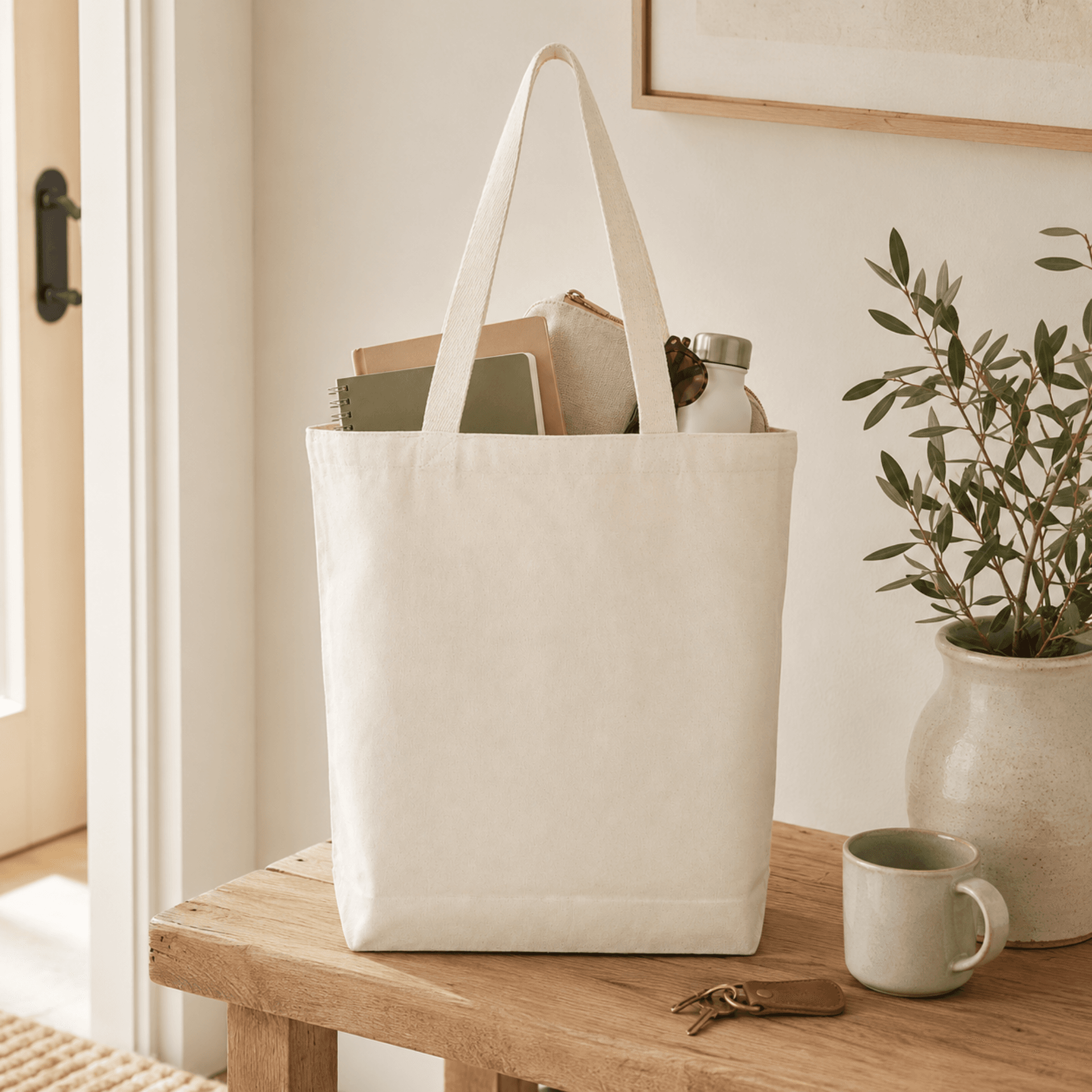
When you source totes at volume, three materials cover almost every quote you'll receive: cotton canvas, jute, and non-woven polypropylene (PP). They look similar in a thumbnail and overlap in price ranges, but they behave very differently once a logo is printed and the bag goes into real use. This canvas vs jute tote bags bulk comparison — with non-woven PP included as the budget option — breaks each material down by its genuine strengths and weaknesses, then lines them up side by side so you can match the material to the job before you commit to a bulk run.
Canvas Tote Bags — Strengths and Weaknesses
Cotton canvas is the all-rounder, and its biggest strength is the print surface. A tight, dense weave gives screen printing a flat, even base, so ink sits sharp and fine detail stays crisp — and the same density anchors embroidery thread without puckering. Canvas is also the durability leader: a heavy 12oz canvas holds its shape fully loaded and survives years of daily carrying. It's machine washable, so a tote that gets dirty goes back into rotation instead of the bin, and canvas is the one material of the three where you can readily source OEKO-TEX Standard 100 certified bags that are independently tested for harmful substances.
The main weakness of canvas is weight and cost. A dense cotton canvas is heavier than jute or non-woven PP, which some buyers notice when a bag is meant to feel light and casual, and it generally costs more per unit than non-woven at the same quantity. For most wholesale programs that trade is worth it, because the durability drives the cost-per-use down over the life of the bag — but if the goal is the cheapest possible single-use handout, canvas is more bag than the job needs.
Jute Tote Bags — Strengths and Weaknesses
Jute's strength is almost entirely aesthetic. The coarse natural fiber has a rustic, earthy texture that reads as premium and sustainable at a glance, which makes jute a favorite for upscale retail bags, gift packaging, and farmers-market styling where the look is the point. Jute is also a fast-growing, biodegradable natural fiber, which supports the natural, eco-forward image many brands want from it.
The weaknesses show up the moment you try to decorate or clean a jute bag. The rough, open weave is a poor print surface — fine detail and small text get lost in the texture, so jute suits simple one-color logos rather than detailed artwork. Jute is not machine washable; it can stiffen, shrink, or distort when wet, so a dirty jute bag is hard to bring back. And the natural fiber can shed, leaving loose strands over time. Jute wins on texture and loses on practicality.
Non-Woven Polypropylene Tote Bags — Strengths and Weaknesses
Non-woven polypropylene is the budget workhorse. Its strengths are price and weight: it's the cheapest of the three per unit, especially at high quantities, and it's very lightweight, which keeps shipping costs down on large orders. For a high-volume, low-cost giveaway where the bag only needs to survive a single event, non-woven PP does the job for the least money.
The weaknesses are where non-woven PP falls behind on everything beyond price. It's a plastic-derived material, so despite being reusable it carries the sustainability problems of plastic — it's not biodegradable, and its eco-credentials are the weakest of the three. The print surface is limited, so logos tend toward simple and flat rather than detailed. And it's the least durable: the fused-fiber construction frays and splits far sooner than canvas, so the bags are reused fewer times before they're discarded.
| Criteria | Canvas | Jute | Non-Woven PP |
|---|---|---|---|
| Print quality | Excellent — tight weave takes fine detail and multi-color cleanly | Poor — coarse texture suits simple one-color logos only | Limited — basic flat prints, little fine detail |
| Durability | Excellent — heavy canvas lasts years of daily use | Moderate — sturdy but can stiffen and shed over time | Low — fused fibers fray and split sooner |
| Machine washable | Yes — wash and reuse repeatedly | No — stiffens, shrinks, or distorts when wet | No — spot clean only; degrades if washed |
| Sustainability | Strong with reuse — natural cotton, OEKO-TEX certified options | Strong image — biodegradable natural fiber | Weak — plastic-derived, not biodegradable |
| Price/unit at 100 qty | Higher — more fabric and durability per bag | Mid — natural fiber at a premium look | Lowest — cheapest per unit at volume |
| Best use case | Premium branding, retail, heavy daily and reusable programs | Upscale gift and retail styling where look leads | High-volume low-cost single-event giveaways |
Which Is Best for Bulk Wholesale Orders?
For most bulk wholesale orders, canvas is the verdict. It wins on the two criteria that decide whether a branded bag works — print quality and durability — and it's the material where verifiable certifications like OEKO-TEX are readily available. A canvas tote carries a sharp logo, survives years of reuse, and keeps your brand in circulation long after the event is over, which is why it's the default for serious programs. You can price it at volume on our canvas tote bags in bulk page.
Jute wins in one specific lane: premium gift and retail contexts where the natural texture is the whole appeal and the bag carries a simple logo rather than detailed artwork. If the look is doing the selling and washability doesn't matter, jute earns its place. Non-woven PP, meanwhile, only wins on price — and it loses decisively on sustainability, so it's hard to justify for any brand that's making an eco claim. Choose non-woven when the budget is the only constraint and the bag genuinely won't be kept.
Canvas Weight and Sustainability
Within canvas itself, the weight you choose changes both durability and the sustainability math — a heavier, tighter weave lasts longer and gets reused more, which is what actually drives a bag's per-use footprint down. If you're weighing 6oz against 10oz and 12oz for a bulk order, our guide to canvas fabric weight and sustainability tradeoffs walks through how weight maps to durability and cost-per-use.
Certifications That Matter
Sustainability claims are only as good as the certification behind them, and canvas is the material where that certification is easiest to verify. If you want to understand what OEKO-TEX and GOTS actually cover — and how to avoid greenwashing in a bulk order — read our explainer on organic and certified canvas tote bags before you commit to a supplier.
Sources & References
OEKO-TEX Standard 100 · U.S. EPA: Trash-Free Waters · Cotton Incorporated