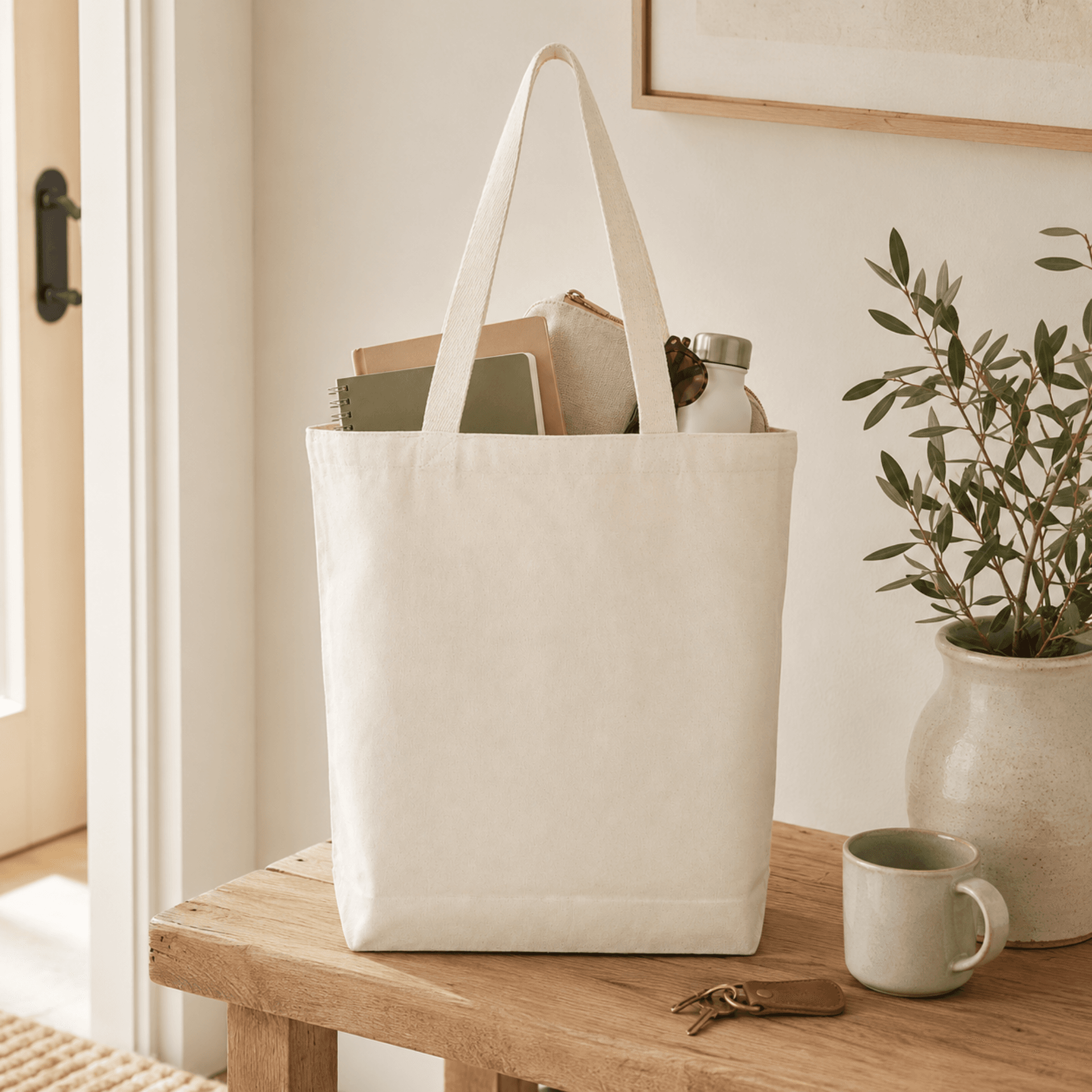
Search for organic canvas tote bags wholesale and almost every listing calls itself eco-friendly, natural, or sustainable. The problem is that none of those words mean anything on their own — there's no legal definition of "eco-friendly" that a supplier has to meet before printing it on a product page. What actually separates a verified claim from marketing copy is third-party certification. A certification is a standard an independent body tests against, and it's the one piece of evidence a bulk buyer can check instead of taking a supplier at their word. This guide explains the two certifications that matter most for canvas totes — OEKO-TEX and GOTS — what each one does and doesn't cover, and how to buy certified bags without falling for greenwashing.
What Does OEKO-TEX Standard 100 Actually Mean?
OEKO-TEX Standard 100 is a product-safety certification. It tests a finished textile for more than 100 harmful substances — things like certain azo dyes, formaldehyde, heavy metals, and residual pesticides — and certifies the product only if every tested component falls within strict limits. The key word is every component: the certification covers not just the main fabric but the sewing thread, the dyes, and any accessories, because a bag is only as safe as its weakest part. If any element fails, the product doesn't get certified.
This is where we can speak from first-hand experience rather than general information. NOVASTILE's canvas tote bags are made with OEKO-TEX Standard 100 certified materials, tested for harmful substances. For a bulk buyer, that matters because it's a verifiable fact about what's in the bag, not a vague sustainability adjective. It tells you the fabric and dyes against your customers' skin — and in the case of totes used around food, your groceries — have been screened to a defined limit by an independent standard.
What OEKO-TEX Standard 100 does not do is make a claim about how the cotton was farmed, how much water the production used, or the labor conditions in the supply chain. It's a safety standard, full stop. Understanding that boundary is the difference between using the certification honestly and overstating it.
OEKO-TEX vs GOTS — What's the Difference?
OEKO-TEX and GOTS are often listed side by side, which leads buyers to assume they're interchangeable. They're not — they answer completely different questions. OEKO-TEX Standard 100 asks "is this product free of harmful substances?" GOTS (the Global Organic Textile Standard) asks "was this fiber grown organically, and was it processed under defined environmental and social rules?" A bag can carry one, both, or neither, and knowing which you actually need keeps you from paying for a certification your use case doesn't require — or claiming one you don't hold.
GOTS is the stricter sustainability claim because it reaches back to the farm. It requires that the cotton be certified organic, sets limits on the chemicals used in processing, and includes social criteria covering working conditions. OEKO-TEX, by contrast, says nothing about farming or labor — it's purely about the harmful-substance content of the finished item. The table below lines the two up against the baseline of no certification at all.
| Criteria | OEKO-TEX Standard 100 | GOTS (Organic) | No Certification |
|---|---|---|---|
| What it verifies | Finished product tested free of 100+ harmful substances | Organic fiber plus controlled processing and social criteria | Nothing is independently verified |
| Covers how cotton is farmed | No — says nothing about farming | Yes — requires certified organic cotton | No |
| Covers harmful substance testing | Yes — this is its core purpose | Yes — limits processing chemicals too | No |
| Covers labor / social standards | No | Yes — includes social criteria | No |
| Independently verifiable by the buyer | Yes — certified product, checkable | Yes — certified supply chain, checkable | No — relies on the supplier's word |
What "Organic Cotton Canvas" Means (and What It Doesn't)
The phrase "organic cotton canvas" is only meaningful when it's backed by GOTS or an equivalent organic certification. GOTS-certified organic means the cotton was grown without synthetic pesticides or fertilizers and the claim can be traced through a verified supply chain. That traceability is the whole value — anyone can call cotton organic, but only a certification proves it.
Watch for softer language that sounds organic but isn't. "Natural cotton" simply means the fabric is cotton rather than a synthetic like polyester — it says nothing about how the cotton was farmed, and uncertified natural cotton can be conventionally grown. "Unbleached" or "undyed" describe the finish, not the farming. None of these are dishonest on their own, but a buyer who reads "natural" as "organic" is making an assumption the supplier never actually stated. If organic farming is a requirement for your program, insist on a GOTS claim you can verify, and treat the absence of one as the answer.
Why Certification Matters for Bulk Buyers
For a one-off personal purchase, certifications are a nice-to-have. For a bulk buyer, they're often a requirement. Companies with ESG reporting obligations need claims they can document, not adjectives — "OEKO-TEX Standard 100 certified" is a line an auditor accepts, while "eco-friendly" is not. The same logic applies to employee gifting and consumer-facing giveaways, where a bag that turns out to be unverified can quietly undercut the sustainability message it was meant to support.
The practical rule is to buy on certifications you can verify and ignore the ones you can't. Ask the supplier which specific standard the bag holds, what it covers, and whether they can point to the certification. If the answer is a wall of green language with no named standard behind it, that's greenwashing — and in a bulk order of hundreds or thousands of units, it's a risk that scales with the quantity.
NOVASTILE's Canvas Tote Bags — What We Can Verify
Here's what we can state plainly about our own bags. NOVASTILE's canvas totes are 100% natural cotton canvas made with OEKO-TEX Standard 100 certified materials, tested for harmful substances, and built in a heavy 12oz weight with reinforced stitching for repeated reuse. We don't hold a GOTS organic certification, so we don't claim organic farming — the honest claim we stand behind is the harmful-substance testing OEKO-TEX covers. You can see the full specs and bulk pricing tiers for our organic canvas tote bags bulk range on the main wholesale page.
Canvas vs Jute — Which Is More Sustainable?
Certification is only one part of the sustainability picture — the base material matters too, and canvas, jute, and non-woven polypropylene each make different trade-offs on durability, reuse, and footprint. The short version is that a bag's real environmental impact depends heavily on how many times it's actually reused, which favors durable, washable materials. For the full breakdown, read our canvas vs jute sustainability comparison, which weighs each material side by side for bulk buyers.
Sources & References
OEKO-TEX Standard 100 · Global Organic Textile Standard (GOTS) · Cotton Incorporated